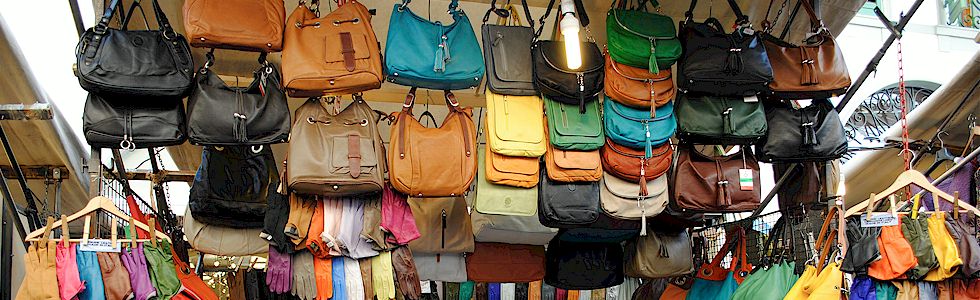
17Nov 0 Italian Leather Goods Posted By: Anna Maria Baldini Activities for visitors to Tuscany, Tuscany travel advice, Tuscany travel guide Italian Leather GoodsBuying handmade Italian leather products in Tuscany - handbags, purses, shoes, accessories Italy is one of the leading countries in the world market of leatherwear, shoes and other leather goods and Tuscany is famous for its artisanal crafts and products. The quality of the handmade leatherware is very high and, generally, based on a long, local tradition. Tuscany is particularly known for its leatherworking tradition and its great experience in the production of high quality leather handbags, shoes, purses and jackets, as well as wallets, belts and other leather accessories. A significant part of the branded leather accessories (Gucci, Armani, Prada etc.) is produced in local factories in Tuscany and also near Milan, the fashion centre of Italy. Given the diversity of leather products available and the comparatively high cost of Italian leatherwear, buyers might wonder what makes Italian leather unique, and whether or not it is worth the price. The primary distinction of Italian leather goods is the quality of the leather itself and of the design and workmanship. Leather goods producers in Italy consistently offer very high quality products, in contrast to the often shoddy production and badly-imitated designs seen from other regions of the world. Leather is made by subjecting the hide of an animal to a lengthy treatment process. People have been working with leather for thousands of years and Italy has been famous for leather production for centuries. Florence is particularly famous for its leather, and in Milan, Italy’s capital of fashion, Italian leather is used almost exclusively by high fashion houses. Because Italian brands tend to dominate the fashion world, Italian leather has come to be closely associated with quality, fashion and good taste. Thanks to the associations with chic culture, buyers are willing to pay a premium for products made with Italian leather, perpetuating the market and promoting the maintenance of high standards at facilities which process Italian leather goods. Where and how to buy Italian leather goods in Tuscany There are four broad options for leather goods shopping in Tuscany. 1) In Florence, there are numerous high-end boutiques and designer shops, for example on via Tournabuoni (Gucci, Ferregamo etc) – here you are guaranteed the genuine article, the latest styles and the prices to match. These prices can be higher than you would pay in your home country but, on the other hand, if you see a beautiful piece . . . will you be able to find it back home? Sales on via Tournabuoni take place in July (and they are good!). Some but not all leatherwork schools, notably one at Piazza Santa Croce, offer one-of-a-kind items of absolutely top quality – the prices are often very high. (Note that the leather shops in Piazza Santa Croce sell mostly junk to the tour buses.) A small step down from the high-end boutiques are shops that sell top quality, non-trademarked leatherwear, the best being south of the Arno in Oltrarno. 2) Also in Florence, there are leather markets where stalls, shops and factory outlets are concentrated. The most famous is San Lorenzo Market, but better quality may be found at the Mercato del Porcellino. The shops behind the stalls offer a better range and quality of items than the stalls even though they often have the same owners. These markets are for those who really know what they are looking for and who can recognise style and quality when they see it – or even just know the difference between vinyl and leather. Over 90% of the goods sold in San Lorenzo currently are rubbishy Asian imports. There are many reports of nice-looking items that fell apart a few weeks after purchase due to bad stitching, for example. Bargaining is necessary at San Lorenzo. There is no guarantee that what you buy isn’t a Chinese knock-off (from China or a Chinese factory in Tuscany). This applies particularly to jackets, which are not a Florentine speciality, but in fact a significant proportion of all goods offered in San Lorenzo market are “faux” this and that, and often astonishingly shoddy. San Lorenzo market is currently a pickpockets’ paradise. Anything offered by an itinerant street vendor will be fake and you can be fined for buying a fake of a branded item. 3) “Outlets” meaning shops that sell last years’ Gucci, Ferregamo, Valentino, Armani, Fendi, Prada, etc. fashions (e.g. Lo Spaccio, The Mall). These places are outside Florence and are the subject of very mixed reports – some find incredible bargains, others spend a day to end up empty-handed. However, all the items on sale are dramatically marked down and they are, of course, genuine. Click here for more on Outlet shopping. 4) Factory shops and showrooms. Some of the factories that manufacture leather goods also have sales points or even showrooms attached to the factory. These factories are sometimes in Florence itself while others are in neighbouring towns. The quality and prices are usually extremely good. These same factories supply the fashion houses but they are absolutely prohibited from selling fashion house designs with or without the house label. If they try it and are caught, they lose their contract which basically means they go bust (and a few have). Don’t believe anyone claiming to have access to unlabelled fashion house designs. On the other hand, they often have very good designs of their own and the quality of the leather and the workmanship is on the same level as the high fashion items. Italian leather goods and leather-working machinery producing areas There are three major areas of Italy where leatherworking is very important and, not surprisingly, two of these areas are also centres for the production of tanning machinery. 50% of the world demand for machinery for footwear and leather goods and 80% of tanning machinery is produced in Italy. The first leatherware area is around the town of Santa Croce sull’Arno across the Arno from San Miniato. Although in the province of Pisa, this area, along with Empoli, is tightly bound economically to Florence. Tanning began here in the mid-19 C, and today 35% of Italian leather production and 98% of Italian leather soles are produced here, for an overall turnover of almost €2 billion. The leather-working machinery sector at Santa Croce sull’Arno represents 30% of Italian production. The district contains around 900 companies with an average size of around 12 employees per business. This latter point is important. Speciality production by small and therefore flexible firms is central to the success of the leatherware industry in exactly the same way as it is to the Italian steel industry where the ability to do small runs to unusual specifications has saved the entire sector. This in turn is related historically to the artisan tradition of Tuscany and elsewhere in Italy. The second district that has been important historically is that of Vigevano, in Lombardy. This area has been subject to severe pressure over recent decades, on the one hand from the market with a shift in consumer interest towards sports footwear, and on the other from the price war waged by lower quality goods produced both in areas of Italy in which the sector has recently developed and in other countries, especially in Eastern Europe. Vigevano responded by concentrating on shoe production for the top end of the market, but above all by ever greater specialisation in two sectors: footwear and footwear machines. The former includes the entire production cycle of the preparation and tanning of leather and the manufacturing of shoes, bags and various kinds of leather accessories. The latter, now quite important, specialises in making machines for tanneries, shoe factories, leather factories, sole and uppers workshops and for the production of soles in synthetic material, together with moulds and spare parts. The Region of Le Marche has the biggest hides, leather and footwear industry in Italy in terms of numbers of companies and workers. The annual turnover is around €2 billion and more than 50% of the whole Italian leather goods and shoe production comes from Le Marche. The economy of the Region is based on a widely-spread network of very small, family-run businesses once again providing the great advantage of flexibility. The Region’s companies are able both to adapt production to the rapidly changing needs of the global market and, indeed, to survive periods of economic recession. Anna Maria Baldini Here are some similar topics: Outlet Shopping Tuscany Which fashion outlets are located in Tuscany? There are three Outlets in Tuscany, all best accessed from Florence or nearby. The Gucci outlet is in Leccio Reggello where you can buy last season’s Gucci items at more than 50% off.… Read More » Montelupo Fiorentino Montelupo Fiorentino is historically and also today one of the most famous centres of painted majolica and ceramics production in Tuscany, and is within easy reach of Florence. … Read More » Tuscany Italy This is the site map for our Tuscany, Italy, website. To make the best use of our web site we advise returning to the home page or utilising the navigation menu to the left.… Read More » Italian traffic tickets Five facts you need to know about traffic violations, ticketing and fines in Italy: 1) Local authorities around the world generate a significant proportion of their revenue from fines levied for infractions of various non-penal laws, notably driving regulations. … Read More » Learn Italian in Tuscany or via Skype Lorella Federico offers Italian lessons at all levels for individuals and small groups visiting Chianti. Lorella, who is a professionally trained Italian language teacher, lives in Panzano in Chianti. You can attend lessons at her location or, if you are… Read More »