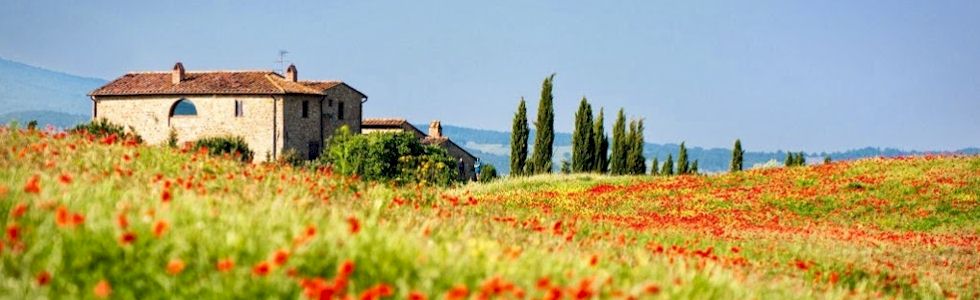
09Dec 0 The “Agriturismo Experience” Posted By: Anna Maria Baldini Chianti, Italy, Tuscany travel guide, Vacation accommodations in Tuscany The "Agriturismo Experience"Making an agriturismo in Tuscany your vacation baseWhat is the "agriturismo experience" and is it for you? The term “agriturismo” has a legal meaning in Tuscany even though it is sometimes used loosely to refer to any rural holiday accommodation. An agritourism is a working farm – in Tuscany invariably a winery and/or producer of olive oil – that offers accommodation to tourists in the form of whole houses, apartments or rooms. These rural vacation rentals are almost always extremely good value for money. They are usually well-restored – beautifully restored in many cases, furnished country-style – sometimes with genuine antiques, often provide a swimming pool and have well-equipped kitchens or kitchenettes. Even taking into account just the number of beds, the prices are highly competitive in comparison with hotels. And a stay out in the Tuscan countryside with a swimming pool and a magnificent view over the vineyards and olive groves beats a hotel any time. Bugs: Agriturismi are in the country – by definition – and therefore you are bound to encounter what our American compatriots call “bugs” – not just members of the Hemiptera but insects in general plus diverse scorpions, centipedes and spiders – outside and sometimes also inside your accommodation. If you don’t like “bugs”, owls, lizards, snakes, porcupines, mice, wild boars, hares, bats, birds large and small, it could be that an agritourism is not for you and that you would be happier in a city or town hotel. If, on the other hand, you would quite like to get in touch with what used to be “real life” for everyone, then make an agriturismo your base in Tuscany and have a great vacation! Mosquitoes and midges: in summer, at night and especially where there is standing water (for example, after a few days of rain), mosquitoes and another biting insect that we can call a midge become highly bothersome. Window screens are rare because they impede the circulation of air at night when one cools the house down by opening the windows. You must therefore take three precautions: a) use your mosquito net when sleeping; b) at night, activate an insect repellant of the “coil” type or its variants – burning candle repellants (these also work well outside if you’re planning a dinner out on your terrace) and electric socket plug-in units; c) carry a tube of anti-histamine gel and apply it immediately and liberally if you are bitten. The latter applies also during the day if you happen to be bitten by a flying ant. All of these items are readily available and widely used in Tuscany. Citronella candles can be replaced by a unit that slowly releases insect repellent from tiny canisters when it is placed under your outdoor dining table. My experience shows that this forms the Bermuda triangle of mosquitoes for several meters in every direction. You might also want to make use of an insect repellent if experience has shown that you attract mosquitoes.Those containing DEET (N,N-diethyl-meta-toluamide) as the active ingredient are often highly effective in repelling biting pests such as mosquitoes and also ticks. Products containing DEET include a variety of liquids, lotions, sprays and impregnated materials (e.g. wrist bands – reported to be ineffective in scientific tests) and can contain from 4 to 100% DEET, 10 to 30% active ingredient being effective. “OFF! Deep Woods” (SC Johnson) contains about 24% DEET and works well for 3-6 hours after application. Apply DEET products to exposed skin only. When applied to skin under clothing, DEET (like many other chemicals) is absorbed at an increased rate into the body and that’s not a good idea. Citronella-containing skin products (e.g. various Avon creams) are reported to be much less effective. However “Skin-So-Soft Bug Guard Plus” (Avon) contains IR3535 and is good for 10 mins to as long as an hour after application. Vitamin B1 (thiamine chloride), garlic, brewer’s yeast and other plant-derived chemicals have been reported to repel mosquitoes when taken orally but there is no scientific evidence to support these claims. Air conditioning: many visitors to Tuscany come from parts of America where the heat and humidity are such that one cannot live without air conditioning. They naturally ask whether they will need air conditioning when they stay in Tuscany. The answer is that you will not need air conditioning unless you are unusually sensitive to heat or are renting an attic apartment directly under a roof. Air conditioning is rare in Tuscany, aside from in large hotels, for three reasons: a) the thick walls of country houses act as a heat sink so that, except for one or two days a year, air conditioning is not needed. Normally one opens the shutters and windows at night to let the cool air in, and closes both shutters and windows during the day to keep the heat out; b) the exorbitant cost of electricity makes running air conditioning prohibitively expensive; c) extremely comprehensive architectural protection laws prohibit the hanging of air conditioning units from windows, leaving only the much more expensive and often impractical internal ducted option. More about electricity, natural gas and water supply at your Tuscan agriturismo. NEVERTHELESS, if you are sensitive to heat or wish to keep the windows closed at night to keep the mosquitoes out, there are some air conditioned accommodations available. Here’s a link to air conditioned vacation rentals in Tuscany. A plea to visitors: although some of the larger estates might be run by somewhat remote managers, most agriturismi are family farms operated by their owners. Please realise that these very busy people are welcoming you into parts of their own homes, that their relationship with you is therefore not just or even primarily pecuniary. Their aim is your comfort and pleasure – please be friendly and responsive in return. The furnishings of your rooms could well be family heirlooms and at the very least a busy farmer or his wife has to clean up when you depart. Please don’t leave the place like a pigsty. Finally, on the European continent, natural gas and electricity cost a fortune. If your apartment is too hot, turn down the radiators rather than opening all the windows while leaving the heating going full blast. Please turn off the lights and air conditioning, if any, when you go out. Last but not least, please don’t fire off ten email enquiries with the idea of selecting your choice when the replies arrive. Agriturismi are not hotels. They do not have staff sitting around and paid to answer emails. After a hard day at work, someone has to respond to your email in an unfamiliar language. It’s quite dispiriting to answer questions and then never hear from the sender again. Instead, select the accommodation of your choice, request your reservation or information, and if there’s no availability or you decide that’s not the place for you, send off your next enquiry. Tuscany accommodation links We have divided up our vacation rental links roughly by type of accommodation. Authentic agriturismi (working wineries) in the Chianti Classico wine territory – click. Other country and village vacation accommodation in the Chianti Classico wine territory – click. Villas and luxury hotel accommodations in Tuscany – click. Vacation accommodations in the Maremma between Siena and the Mediterranean beaches –click. Accommodations in and near Rome – click. Villas, apartments and Bed & Breakfast in Rome and the Roman Campagna – click. For a complete range of hotels throughout Tuscany, click here. Here are some similar topics: Bed and Breakfast in Chianti One of the most convenient forms of accommodation in Chianti and Tuscany is a Bed and Breakfast (B&B) in Chianti. These can be located in both the countryside and the small towns and villages of the Chianti Classico wine territory… Read More » Chianti Agriturismi The vacation rentals listed here are all genuine agriturismi, meaning that you will be staying on an authentic Tuscan farm, usually but not always a winery. Almost all are producers of Tuscan olive oil. One or two agriturismi produce only… Read More » Types of vacation accommodations in Tuscany One of the pleasures of a vacation in Tuscany is the wide selection of comfortable accommodations that are available. Holiday lodgings range from Tuscan villas, through farmhouses (case coloniche), vacation apartments to B&B rooms.… Read More » Accommodations in Chianti The Tuscany holiday accommodations listed here are located in both the countryside and the small towns and villages of the Chianti Classico wine territory. They are often near wineries but are not working vineyards themselves.… Read More » Lodgings near Florence Since Renaissance times, the inhabitants of Florence have sought tranquility and cool breezes during summer by staying in Tuscan villas and on farms in the surrounding Tuscan hills. This is still an excellent strategy, not just for Florentines but also… Read More »