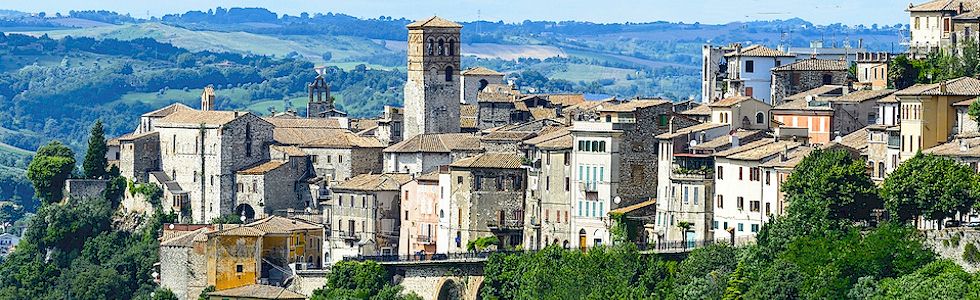
23Nov 0 Narni Posted By: Anna Maria Baldini All about Umbria, Sights of Umbria, Towns in the Province of Terni, Umbria, Towns of Umbria Narni Tourist InformationArt, architecture and festivals of Narni in Umbria, Italy Corsa all’Anello Festival, Narni The Narni Tourist Information Office, Associazione Turistica Pro-Narni, is located at Piazza dei Priori, 3, and their well-informed staff will answer your questions and provide you with tourist information pamphlets and maps. Narni in Umbria is first referred to as “Nequinum”, a populated nucleus dating back to about 600 BC. By 299 BC, Narni had become a Roman colony named “Narnia”. The name comes from the nearby Nar river, which is called the Nera today. In 233 BC, Narni became an important fort along the newly constructed Via Flaminia, and in 90 BC it became a township. The Roman emperor Nerva was born at Narni. Narni suffered from the invasions of the Longobards and Goths due to its militarily important position, but nevertheless flourished and became a free town in the 11 C. Narni reached its period of major splendour during the 12 C and the 14 C. During the Renaissance, the Narni was often the working location of famous artists including Rossellino, Ghirlandaio, Vecchietta, Antoniazzo Romano and Spagna. In 1527, Narni was betrayed and fell to the Lanzichenecchi, who sacked it. Artists such as the Zuccaris, Vignola, Sangallo and Scalza participated in restoring the town, and in 1664 the municipal library was founded. The Duomo of Narni Sights of Narni The Roman Bridge of Augustus was built in 27 BC, and was one of the two tallest road bridges ever built by the Romans, along with the Alcántara Bridge in Spain (ca. 42 m high). The Narni Roman bridge was 160 m long and its remaining arch is 30 m high. The view of the bridge is extremely romantic and among the many artists who painted it the best known is Jean-Baptiste-Camille Corot whose famous 1826 painting, “The Bridge at Narni”, hangs in the Louvre. (More about Roman Umbria.) The Cathedral (Duomo) is Romanesque and contains works by Rossellino and other famous artists. The Church of St. Francis dates from the 8 C and contains School of Narni frescoes. The Palazzo dei Priori was constructed in 1275 probably by Gattapone of Gubbio and is situated in the mediaeval square of the same name. The Town Hall was constructed in 1273 by uniting three towers. Inside, one can admire the Coronation of the Virgin , painted in 1486 by Ghirlandaio, St. Francis with Stigmata by Spagna, the Annunciation by Benozzo Gozzoli and an Egyptian mummy of the 4 C BC. At the back of the square, there is a fountain dating back to the year 1303. The Scotti Palace contains its frescoes by Zuccari (1581). The Gardens of St. Bernard, from which there is a view of the splendid Nera valley, provides an entry to the subterranean rooms of St. Dominic The antique Church of St. Dominic is now the location of the Library and the State Archives The Church of St. Restituta and the adjoining convent complex include the Church of St. Augustine (14 C), which is rich in works of art, and the Church of St. Margaret with an interesting cycle of frescoes attributed to Pomarancio. Just outside Narni is the mighty Rocca Albornoz which was constructed around the year 1370 by Ugolino of Montematre for Cardinal Egidio Albornoz and has been restored recently. The Cave of St. Francis, 18 km from Narni, has interesting 14 C and 15 C frescoes. The fortified Abbey of St. Cassiano (Abbazia di San Cassiano) is located right in front of the Narni. The Abbey of St. Angelo in Massa. The proto-Romanesque Church of St. Pudenziana, 6 km from Narni. Corsa all’Anello Festival The Corsa all’Anello Festival is one of the best mediaeval festivals held in Umbria. Worth a visit. More about the town of Narni in Umbria. Narni festival Here are some similar topics: Spoleto Spoleto is well worth a visit both on account of its wonderful location on the slopes of the Apennines and for it Roman, mediaeval and Renaissance art and architecture. The history of Spoleto is long and illustrious and this is… Read More » Roman Umbria Many Roman ruin and Roman history enthusiasts visiting Italy might be unaware that, in addition to Pompeii and Herculaneum, there are many splendid Roman remains to be found outside of Rome and its environs. A great many of these are… Read More » Spello Spello is vastly under-rated as a place to visit in Umbria, Italy. This quiet Umbrian hilltop (or, rather, ridge-top) town is a pleasure for those who love to explore the integration of Roman structures into a living town. Three well-preserved… Read More » Todi Todi was important to both Etruscans and Romans and is the location of several interesting Gothic and renaissance buildings, including the 11 C cathedral and 13 C palazzi. Its triple walls are still easily discerned. The innermost is Etruscan, the… Read More » Orvieto Orvieto, Italy is situated on the flat summit of a large butte of volcanic tuff, one of the most dramatic townscapes in Europe, rising above the vertical cliffs that are extended by defensive walls of the same stone. The facade… Read More »